Electrical Tips
Electrical Panel Upgrade for Solar in Los Angeles
Updated 6 min read
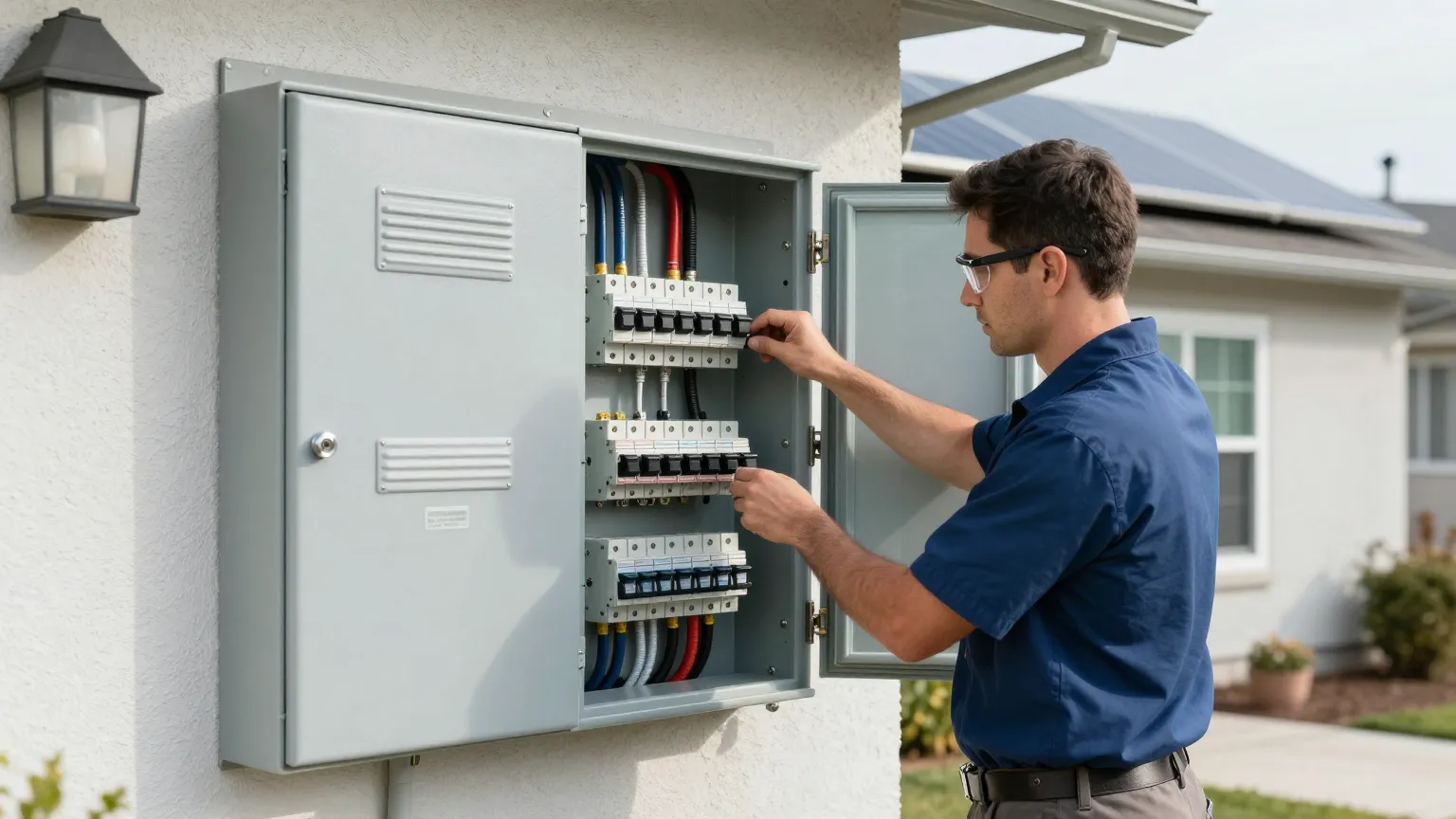
Most Los Angeles homeowners find out they need an electrical panel upgrade for solar late in the process — usually after the site survey, when the installer says the existing panel cannot legally accept the new system. Understanding why that happens ahead of time saves weeks of delay and keeps the surprise off your final invoice.
Why Solar Forces the Panel Question
A solar system does not just draw power from your panel; it pushes power back into it. That backfeed lands on the panel's busbar — the metal spine every breaker clips onto. The busbar has a fixed amperage rating, and code limits how much combined current can be applied to it.
Panels installed in LA homes before the 1990s are frequently 100 amp or smaller, and many were already near capacity before anyone thought about solar, EV charging, or heat pumps. That is the crux of the problem: the roof array is fine, the panel is the bottleneck.
The 120% Rule, Explained Without the Code Book
The National Electrical Code allows the sum of your main breaker plus your solar backfeed breaker to reach up to 120% of the busbar rating. Run the math and the constraint becomes obvious:
- 200A busbar with a 200A main: 240A allowed − 200A main = 40A available for solar, or roughly a 7.6 kW inverter.
- 125A busbar with a 125A main: 150A allowed − 125A main = 25A available, roughly 4.8 kW.
- 100A busbar with a 100A main: 120A allowed − 100A main = 20A available, roughly 3.8 kW — usually too small for a modern array.
If your planned system exceeds that headroom, something has to change. There are a few ways to solve it, and they are not equally good.
Your Options When the Panel Won't Take the Solar
1. Upgrade the service panel
Replacing a 100A or 125A panel with a modern 200 amp service is the cleanest fix. It clears the 120% math, gives you room for a battery, an EV charger, and future electrification, and brings grounding and bonding up to current code in the process. It is the option we recommend most often in older Pasadena, Altadena, Highland Park, and San Fernando Valley homes.
2. Derate the main breaker
Swapping a 200A main for a 175A main on a 200A busbar frees up 65A of backfeed capacity without a full panel replacement. It is cheap and fast — but it only works if a load calculation shows your home genuinely does not need the full 200A. Add an EV charger or a heat pump later and you may be right back where you started.
3. Line-side (supply-side) tap
The solar connects ahead of the main breaker instead of onto the busbar, sidestepping the 120% rule entirely. It works well in some installations, but not every panel or meter configuration allows it, and utility approval varies. An electrician needs to look at your actual service equipment before promising this route.
Permits and Utility Interconnection in Los Angeles
Solar in LA involves two separate approvals, and the panel work sits in the middle of both. Expect this sequence:
- Load calculation and panel scope — determines whether an upgrade, a derate, or a line-side tap is appropriate.
- Building permit — through LADBS, or through your own city if you are in Pasadena, Burbank, Glendale, or Arcadia. Solar and the panel upgrade are often permitted together.
- Utility coordination — LADWP or Southern California Edison, depending on your address. The panel replacement requires a service disconnect and reconnect at the meter.
- Inspection, then Permission to Operate — the system cannot be switched on until the utility signs off. Panel problems discovered at inspection are the most common cause of delay.
Doing the panel work first, or at least having it fully scoped before the solar contract is signed, is the single best way to avoid a stalled project. Our electrical panel upgrade page covers the service-size options in more detail.
What It Costs in Los Angeles
Ranges vary with service size, meter location, and how much of the existing service entrance can be reused:
- 100A/125A to 200A panel upgrade, same location: roughly $2,500–$4,500 including permit.
- Upgrade with meter relocation or a new mast: roughly $4,500–$8,000+.
- Main breaker derate only: typically a few hundred dollars, when a load calculation supports it.
- Adding a battery-ready subpanel or critical loads panel: commonly $1,500–$3,500 on top.
Treat those as planning ranges, not quotes — prices, rebates, and incentives change, and every service is different. Verify current incentives with your utility and get a written estimate after an on-site evaluation.
Plan for the Battery and the EV Too
California's shift to net billing has made solar plus storage the more common configuration for new residential systems, since exported power is worth less than it once was. That matters for panel sizing: a battery needs its own breaker space and often a critical loads subpanel. If a Powerwall or home battery or an EV charger is anywhere in your five-year plan, size the panel for all of it now. Doing the service upgrade once is dramatically cheaper than doing it twice.
Frequently Asked Questions
Do I need to upgrade my electrical panel for solar?
Not always. If you have a 200A panel with a 200A main and a modest array, you may fit within the 120% allowance as-is. Homes with 100A or 125A service, or with older Zinsco or Federal Pacific equipment, almost always need the upgrade before a system can be approved.
What is the 120% rule for solar?
It is the NEC limit on backfeed: your main breaker plus your solar breaker cannot exceed 120% of the panel busbar's rating. On a 200A busbar that caps the combined total at 240A, which is why a 200A main leaves only about 40A for solar.
How much does a panel upgrade for solar cost in Los Angeles?
Most straightforward 200A upgrades run about $2,500–$4,500 including the permit, with higher figures when the meter, mast, or service entrance also needs work. An on-site look is the only way to get a firm number.
Can a line-side tap let me skip the panel upgrade?
Sometimes. A supply-side connection bypasses the busbar limit, but it depends on your specific service equipment, available space in the meter section, and utility acceptance. It is a legitimate option worth evaluating — just not a guaranteed one.
Should the panel upgrade happen before or during the solar install?
Before, or bundled into the same permit. Discovering the panel is undersized after the array is on the roof means a second permit, a second inspection, and a delayed Permission to Operate. Scope the panel during the design phase.
Get the Panel Sorted Before Your Solar Install
911 Construction & Electric Inc. is a licensed, bonded, and insured C-10 electrical contractor (CA Lic. #1027421) serving Pasadena, Burbank, Glendale, Altadena, Arcadia, Highland Park, Eagle Rock, the San Fernando Valley, and greater Los Angeles. We will run the load calculation, tell you honestly whether you need an upgrade or a derate, handle the permit and utility coordination, and give you a free estimate. Contact us here or call 747-255-8595. 24/7 emergency service available.
Keep Reading
5 min read
Electrical Preventive Maintenance in Los Angeles
A loose lug or a scorched neutral rarely announces itself. It shows up as a breaker that trips on the hottest afternoon of the year, or a tenant calling at closing time about ha…
Read article →
6 min read
Electrical Panel Maintenance in Los Angeles: Checklist
Most homeowners service the furnace, flush the water heater and change the HVAC filter on a schedule. The electrical panel — the single component every circuit in the building d…
Read article →
6 min read
Home Battery Backup Installation in Los Angeles
A red-flag wind warning goes up, the power drops, and suddenly the most important appliance in the house is the refrigerator. That is usually the moment Los Angeles homeowners s…
Read article →Have an electrical project in mind?
Talk to a licensed electrician today — free estimates, 24/7 emergency service.