Electrical Tips
Arc Fault Breaker Keeps Tripping in Los Angeles
6 min read
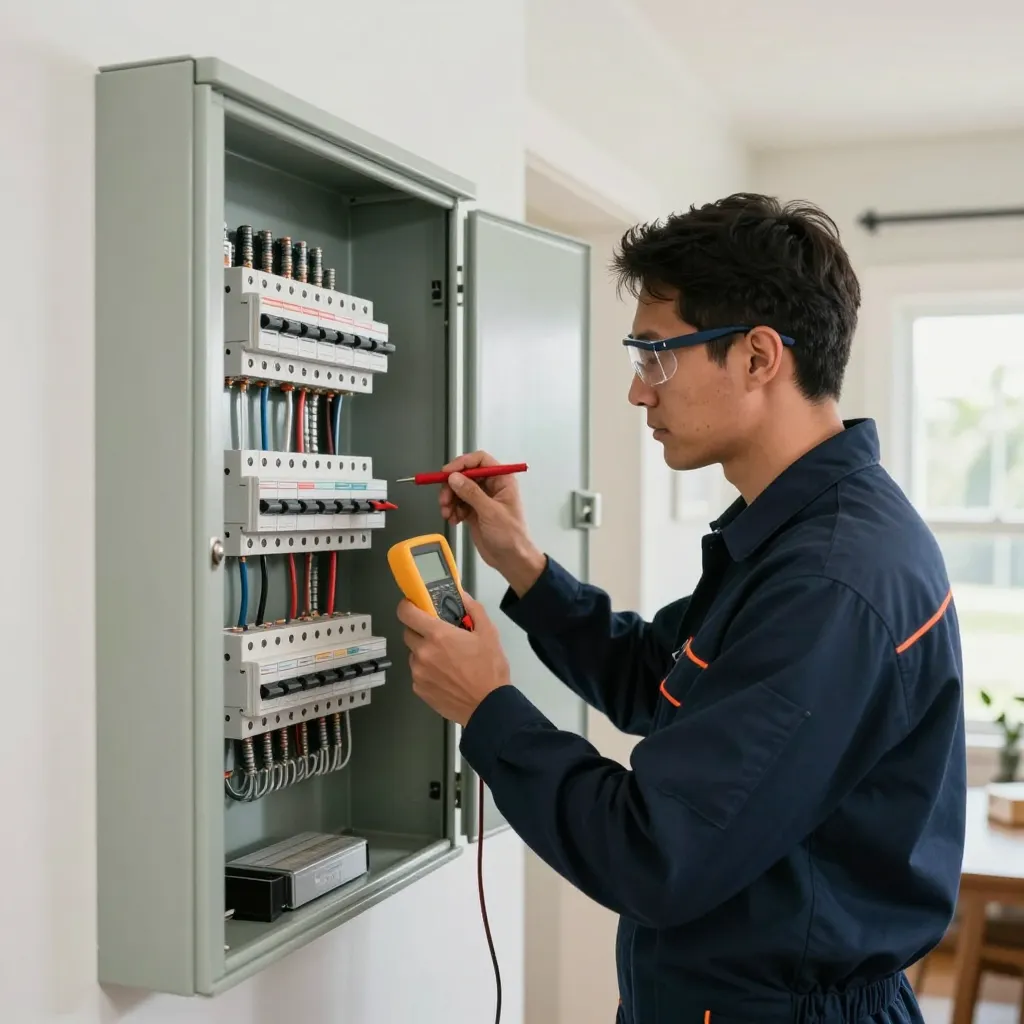
You reset the breaker, everything runs fine for two hours, and then the lights in half the house go out again. When that pattern repeats on a breaker with a small TEST button on it, you are almost certainly dealing with an arc fault breaker — and the reason it keeps tripping matters more than most homeowners realize.
What an AFCI Breaker Actually Does
An AFCI breaker — short for arc fault circuit interrupter — does something a standard breaker cannot. A regular breaker only watches for too much current. An AFCI listens to the waveform for the erratic signature of an arcing fault: a loose wire nut, a nail driven through Romex, a cracked lamp cord, a corroded connection behind an outlet. Those arcs burn hot enough to start a fire long before a standard breaker would notice.
So a tripping AFCI should never be worked around — sometimes it is genuinely catching a problem inside your walls. Our guide to GFCI and AFCI outlet installation covers where each type of protection belongs.
Why Your Arc Fault Breaker Keeps Tripping
Trips fall into two buckets, and telling them apart is the whole job.
1. A real arcing fault
This is the outcome the breaker exists for. Common sources in Los Angeles homes:
- Loose or backstabbed connections at outlets and switches that have worked loose over decades
- Damaged cable from a picture hanger, drywall screw, or a past remodel that nicked the insulation
- Deteriorated insulation in pre-1970s wiring, especially where old cloth-covered wire meets newer circuits
- Rodent damage in attics and crawlspaces — common in hillside neighborhoods like Eagle Rock and Altadena
- A failing appliance, extension cord, or plug with an internal break in the conductor
2. Nuisance tripping
Sometimes the circuit is fine and the breaker is reacting to electrical noise. Nuisance tripping is most often caused by:
- Motor-driven or electronically switched appliances — vacuums, treadmills, older refrigerators, some LED drivers and dimmers
- A shared neutral between two circuits, common where a multi-wire branch circuit predates AFCIs
- A neutral wire touching a ground or a neutral connected to the wrong bar inside the panel
- An early-generation or off-brand AFCI breaker that is simply oversensitive or has failed internally
You cannot tell these apart by how the trip feels. A licensed electrician isolates the circuit, tests it under load, and confirms whether the arc signature is real.
What to Try Before You Call an Electrician
A few safe steps can narrow the problem down and save diagnostic time:
- Unplug everything on the circuit, reset the breaker, then plug items back one at a time to find the device that causes the trip.
- Note the pattern. Trips only when the vacuum runs points toward an appliance; random trips at 3 a.m. with nothing running point toward the wiring itself.
- An immediate trip with nothing plugged in usually means a wiring fault, not an appliance.
- Look for warm or discolored outlet covers, a burning smell, buzzing, or scorch marks — if you find any, stop and call an electrician.
- Do not swap the AFCI for a standard breaker. It is a code violation and it hides the hazard instead of fixing it.
If a breaker will not reset at all, or you smell burning, treat it as urgent and call our 24/7 emergency electricians in Los Angeles. For trips that are not AFCI-specific, our guide on why a circuit breaker keeps tripping walks through overloads and short circuits.
AFCI Requirements in California
The California Electrical Code requires AFCI protection on most 120-volt branch circuits serving living areas — bedrooms, living and family rooms, hallways, dining rooms, closets, laundry areas, and kitchens. In practice:
- New construction and additions must be AFCI-protected throughout the affected living spaces
- Extending or replacing a branch circuit generally means bringing it up to current AFCI requirements
- A panel replacement usually adds AFCI breakers — which is why older homes often start seeing trips right after an upgrade
Local amendments and inspector interpretation vary between the City of Los Angeles, Pasadena, Burbank, and Glendale, so confirm the specifics for your jurisdiction. If your panel is old enough that compliant AFCI breakers are hard to source, an electrical panel upgrade beats chasing individual breakers.
What It Costs in Los Angeles
Prices move with parts, access, and permit fees, so treat these as planning ranges rather than quotes:
- Diagnostics to trace a tripping circuit: a service-call fee plus hourly time, since intermittent arcs can take an hour or several to isolate
- AFCI breaker replacement: a modest parts cost plus labor — usually less than homeowners expect
- Repairing a found fault: varies with access — open-wall work in a finished home costs more than an accessible attic run
- Adding AFCI protection to several circuits during a panel replacement: usually bundled into the panel project
We give a firm number after we see the panel and the circuit. Ongoing work is covered on our electrical repair services page.
Frequently Asked Questions
Why does my arc fault breaker keep tripping with nothing plugged in?
An immediate trip on an unloaded circuit usually points to the wiring rather than an appliance — most often a loose connection, a damaged cable, or a neutral wire that is shared or misconnected inside the panel. That is a diagnostic job, not a reset-and-hope situation.
Is it safe to keep resetting an AFCI breaker?
Resetting once to confirm the trip is reasonable. Repeatedly resetting a breaker that keeps tripping is not — you may be re-energizing an active arcing fault. If it trips more than twice, leave it off and have the circuit inspected.
Can I replace an AFCI breaker with a regular one to stop the trips?
No. Where the code requires arc fault protection, swapping in a standard breaker is a violation, can create problems at resale or during an insurance claim, and removes the only device watching for an arc. The correct fix is finding the cause.
How long does it take an electrician to find the problem?
Straightforward faults are often located within an hour. Intermittent trips take longer, because the circuit has to be tested under the load that actually causes the trip. We tell you what we find as we go.
Do older Los Angeles homes trip AFCIs more often?
Yes, noticeably. Homes in Pasadena, Altadena, Highland Park, and much of the San Fernando Valley often have decades-old branch circuits, shared neutrals, and backstabbed devices — all of which raise the odds of both real arcs and nuisance trips once modern AFCI breakers go in.
Talk to a Licensed Los Angeles Electrician
911 Construction & Electric Inc. is a licensed, bonded, and insured C-10 electrical contractor (CA Lic. #1027421) based in Pasadena and serving Los Angeles, Burbank, Glendale, Altadena, Arcadia, the San Fernando Valley, and surrounding cities. If your arc fault breaker keeps tripping, we will find out why — and fix it properly. Contact us for a free estimate or call 747-255-8595 for same-day and 24/7 emergency service.
Keep Reading
5 min read
Electrical Preventive Maintenance in Los Angeles
A loose lug or a scorched neutral rarely announces itself. It shows up as a breaker that trips on the hottest afternoon of the year, or a tenant calling at closing time about ha…
Read article →
6 min read
Electrical Panel Maintenance in Los Angeles: Checklist
Most homeowners service the furnace, flush the water heater and change the HVAC filter on a schedule. The electrical panel — the single component every circuit in the building d…
Read article →
6 min read
Home Battery Backup Installation in Los Angeles
A red-flag wind warning goes up, the power drops, and suddenly the most important appliance in the house is the refrigerator. That is usually the moment Los Angeles homeowners s…
Read article →Have an electrical project in mind?
Talk to a licensed electrician today — free estimates, 24/7 emergency service.