Electrical Tips
AC Disconnect Installation in Los Angeles: Code Guide
6 min read
Your HVAC crew finishes setting the new condenser, then tells you they can't energize it until an electrician handles the disconnect — and the job stalls. That small gray box costs very little next to the equipment it serves, yet it is one of the most commonly corrected items on a Los Angeles electrical inspection.
Here is what AC disconnect installation involves, how the circuit is sized, and where these projects stall in older LA-area homes.
What an AC Disconnect Actually Does
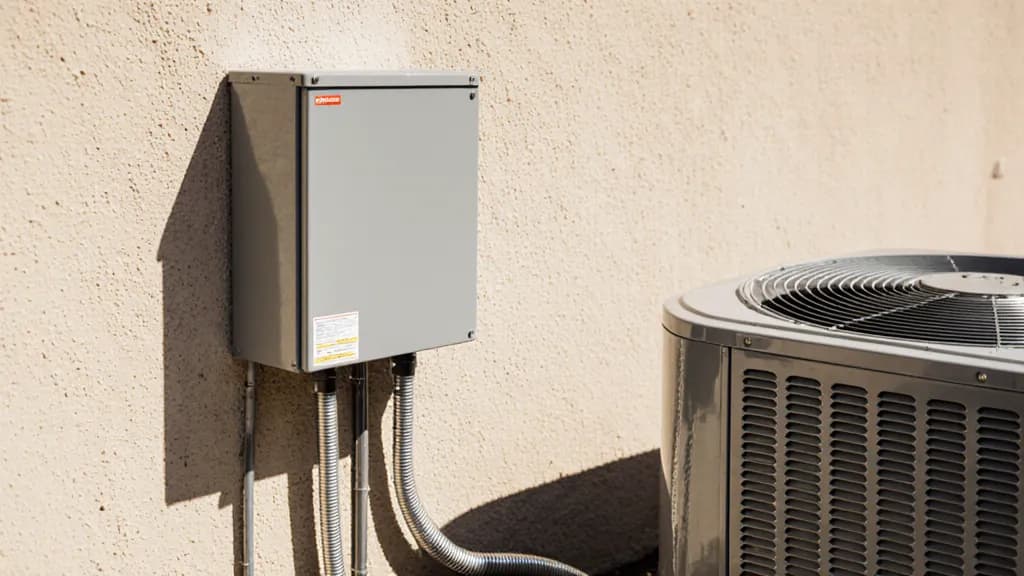
An AC disconnect box — also called an AC disconnect switch or condenser disconnect — is a local shutoff mounted within sight of the outdoor unit, so a technician can kill power at the equipment without walking to the main panel and hoping nobody flips the breaker back on.
Two styles dominate residential work. A pullout (non-fused) disconnect uses a removable block and relies on the panel breaker for overcurrent protection. A fused disconnect holds cartridge fuses and provides that protection locally. The equipment nameplate decides which you need.
When Los Angeles Code Requires a Disconnect
The California Electrical Code — California's adoption of the NEC — requires a disconnecting means for air-conditioning and refrigeration equipment that is readily accessible and within sight of the unit. In practice, inspectors in the City and County of Los Angeles are looking for:
- A disconnect within sight of the condenser and not an unreasonable distance away
- Readily accessible placement — not behind the unit, not blocked by a gate, fence, or landscaping
- A location off the removable service panel of the condenser itself
- A weatherproof enclosure rated for outdoor use
- Fuse or breaker sizing that matches the equipment nameplate
- Clear working space in front of the box
Requirements vary by jurisdiction and code edition, and the inspector on your permit has the final word. A disconnect installed under an older code cycle is not automatically compliant once the equipment it serves is replaced.
Sizing the Circuit: Nameplate First, Always
Every properly sized AC circuit starts at the condenser data plate. Two numbers matter: minimum circuit ampacity (MCA), which drives conductor size, and maximum overcurrent protection (MOCP), which caps the breaker or fuse rating. Tonnage alone tells an electrician almost nothing.
Why "what size breaker for an AC unit" has no single answer
Two condensers of identical tonnage from different manufacturers routinely call for different breakers. Most residential units here land on a double-pole 240-volt breaker in the 20- to 45-amp range, but that is a pattern, not a rule. Oversizing the breaker to "be safe" is a code violation, not a safety margin. The short liquidtight AC whip between the disconnect and the condenser matters too — it must be supported and correctly terminated at both ends.
Does Your Panel Have Room for the New Circuit?
This is where AC projects most often derail. A new condenser, or a move to a larger one, adds load to a panel that may already be full. An electrical load calculation tells you whether your service can carry the equipment, and whether the honest answer is an electrical panel upgrade before the HVAC work proceeds.
That comes up constantly in neighborhoods built before central air was standard — much of Highland Park, Eagle Rock, Altadena, and the older San Gabriel Valley housing stock still runs 100-amp service with no spare breaker spaces. The same math applies when pairing the work with heat pump electrical wiring, or designing it into a new construction electrical plan.
Most of Los Angeles County is served by Southern California Edison (SCE). Several cities we work in run their own municipal utilities with separate programs and service-upgrade processes: Pasadena Water & Power (PWP), Glendale Water & Power (GWP), and Burbank Water and Power (BWP). PWP offers up to $1,000 toward a residential panel upgrade — amounts and eligibility change, so confirm current terms with PWP. In Glendale and Burbank, check that utility's current rebate program rather than assuming SCE figures apply.
What AC Disconnect Installation Costs in Los Angeles
Cost tracks scope, and scope is mostly about what already exists behind the wall. From least to most involved:
- Replacing a failed disconnect on an existing, correctly sized circuit — the simplest and least expensive scenario
- Adding a disconnect plus a new 240-volt circuit from the panel — driven mainly by the conduit run
- Adding the circuit when the panel is full — a subpanel or service upgrade comes first and becomes the bulk of the project
- Permit and inspection fees, which vary by jurisdiction and sit apart from labor and materials
Anyone quoting a firm number before seeing your panel and the proposed run is guessing. Ask for a written estimate naming the circuit, the conduit path, and who pulls the electrical permit.
Signs Your Existing Disconnect Needs Attention
- Scorch marks, melted plastic, or a burning smell at the box — shut the power off and treat it as an emergency electrician call
- A rusted-through enclosure, or a cover that is cracked or missing entirely
- A pullout block that is loose, won't seat fully, or shows pitted contacts
- Fuses that blow repeatedly — a symptom that needs real electrical troubleshooting, not larger fuses
- No disconnect at all — common on older installs and DIY condenser swaps
- Corroded or discolored terminations, especially on aluminum conductors
Frequently Asked Questions
Do I need a permit for AC disconnect installation in Los Angeles?
A new branch circuit for air-conditioning equipment generally requires a permit and inspection. A like-for-like replacement of a failed disconnect may be treated differently by jurisdiction. Your contractor should confirm with the local building department and pull the permit — a bidder who suggests skipping it is a reason to keep shopping.
Does my AC unit need a disconnect if it already has a breaker in the panel?
Yes. The breaker protects the circuit, but it is not within sight of the condenser, so it does not satisfy the local disconnecting-means requirement. The two serve different purposes and code expects both.
Should I use a fused or non-fused AC disconnect?
The nameplate decides. If the panel breaker already provides overcurrent protection at the specified rating, a non-fused pullout is typically appropriate. If the installation calls for local protection, a fused disconnect with the specified fuse class and rating is required.
Can my HVAC company do the electrical work?
In California, line-voltage branch-circuit work generally falls to a licensed C-10 electrical contractor, while C-20 HVAC contractors have a narrower electrical scope. The boundary can be nuanced, so ask who holds the C-10 license and who pulls the electrical permit. Many HVAC companies subcontract that portion.
How long does AC disconnect installation take?
Swapping a disconnect on a sound existing circuit is often a couple of hours. A new 240-volt circuit from the panel usually runs a half-day to a full day depending on the conduit route. If the panel needs a subpanel or service upgrade first, plan on a longer project with utility coordination and inspection scheduling.
Get the Circuit Done Right the First Time
911 Construction & Electric Inc. is a licensed, bonded, and insured C-10 electrical contractor (CA Lic. #1027421) based in Pasadena, serving Los Angeles and nearby cities including Burbank, Glendale, Altadena, Arcadia, the San Fernando Valley, and the San Gabriel Valley. We handle AC disconnects, condenser circuits, load calculations, and the panel work behind them — permits pulled, inspections scheduled. Request a free estimate or call 747-255-8595. 24/7 emergency service available.
Keep Reading
5 min read
Electrical Preventive Maintenance in Los Angeles
A loose lug or a scorched neutral rarely announces itself. It shows up as a breaker that trips on the hottest afternoon of the year, or a tenant calling at closing time about ha…
Read article →
6 min read
Electrical Panel Maintenance in Los Angeles: Checklist
Most homeowners service the furnace, flush the water heater and change the HVAC filter on a schedule. The electrical panel — the single component every circuit in the building d…
Read article →
6 min read
Home Battery Backup Installation in Los Angeles
A red-flag wind warning goes up, the power drops, and suddenly the most important appliance in the house is the refrigerator. That is usually the moment Los Angeles homeowners s…
Read article →Have an electrical project in mind?
Talk to a licensed electrician today — free estimates, 24/7 emergency service.