Electrical Tips
Electrical Panel Permit Los Angeles: Do You Need One?
5 min read
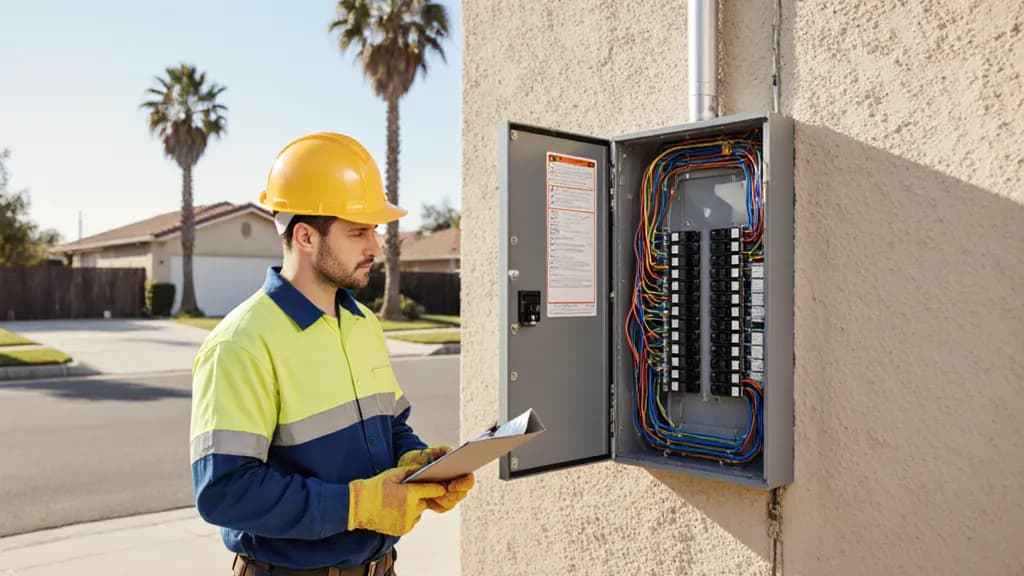
Almost every panel replacement conversation lands on the same question: does this really need a permit, or can we just swap the thing out? In Los Angeles County the answer is not ambiguous — and the reason has less to do with paperwork than with who is legally allowed to touch the service feeding your house.
Short Answer: Yes, a Panel Upgrade Requires a Permit
Every city and unincorporated area in LA County requires a permit for service panel work. An electrical panel upgrade changes the equipment connecting your home to the grid — meter enclosure, main breaker, grounding and bonding, and every branch circuit downstream. No California jurisdiction lets that happen without a record and an inspection.
Work that does require a permit:
- Replacing or upgrading a main service panel
- Relocating a panel to a different wall or to an exterior location
- Increasing service capacity — 100 amps to 200 amps, or 200 to 400
- Adding a subpanel for a garage, ADU, or addition
- Installing a dedicated 240-volt circuit for a Level 2 EV charger
- Replacing a fuse box or obsolete Zinsco / Federal Pacific equipment
Genuinely minor work — a like-for-like breaker, a switch, a light fixture — usually falls outside permit requirements, though thresholds vary by city.
Who Pulls the Permit — and Why It Shouldn't Be You
California does allow a homeowner to pull an owner-builder permit on their own residence. It is usually a mistake: the permit holder carries responsibility for code compliance, correction notices, and re-inspection fees, so if the installation fails it is your name on the record, not your electrician's.
A licensed C-10 contractor pulls the permit under their own license and bond — the paper trail an insurer, appraiser, or buyer's agent will look for years later. Ask any contractor who is pulling the permit before they start; "we don't need one" is the loudest red flag in this trade.
What the Permit Process Actually Looks Like
- Load calculation and scope — sizing the new service to real demand rather than a round number.
- Permit application with the local building department. The City of Los Angeles goes through LADBS; Pasadena, Glendale, Burbank, Alhambra and the other San Gabriel Valley cities each run their own counters and fee schedules.
- Utility coordination — scheduling the disconnect and reconnect at the meter, the step homeowners most often underestimate.
- Installation — commonly a single day for a straightforward residential service swap.
- Inspection — verification of panel installation, grounding and bonding, breaker sizing, circuit labeling, working clearances, and AFCI/GFCI protection.
- Final sign-off and meter release, after which the utility restores permanent power.
Where Your Utility Fits In
Most of Los Angeles County sits in Southern California Edison (SCE) territory, but several cities we serve run their own municipal utility — and the disconnect scheduling and rebate paths are not the same:
- Pasadena Water & Power (PWP) — municipal. PWP offers up to $1,000 toward a panel upgrade and up to $600 toward a home EV charger. Amounts and eligibility change, so confirm current terms with PWP.
- Glendale Water & Power (GWP) and Burbank Water and Power (BWP) — also municipal, each with its own incentive programs. Check the utility's current rebate program rather than assuming a figure you read elsewhere applies.
- Everywhere else we serve — SCE handles the disconnect and reconnect, and SCE's own rebate rules apply. Unlike SCE customers, Pasadena homeowners go through PWP for both the coordination and the rebate.
What a Panel Permit Costs
Permit fees are set jurisdiction by jurisdiction and are typically a small fraction of the total job — often in the low hundreds of dollars for a residential service upgrade, scaled by declared valuation and the number of inspections. Some cities add plan-check or utility coordination charges. Fee schedules change, so treat any number as an estimate until the application is filed.
One practical test of a quote: the permit should appear as its own line item. A bid that never mentions permitting is either absorbing a cost it hasn't disclosed or not planning to pull one.
The Real Cost of Skipping the Permit
- Escrow delays — unpermitted service work surfaces in buyer inspections
- Insurance claims questioned or denied after an electrical fire
- A utility that declines to reconnect or release the meter
- Retroactive permits, opened walls, and paying for the job twice
- No record proving grounding, bonding, and AFCI/GFCI protection were verified
If you inherited questionable panel work from a previous owner, an electrical repair and troubleshooting visit can document what is behind the cover before you decide how to handle it. On new construction and ADU projects, the electrical permit is folded into the broader building permit and inspected in stages alongside rough-in.
Frequently Asked Questions
Do I need a permit to upgrade my electrical panel in Los Angeles?
Yes. Panel replacement, capacity upgrades, and relocations all require a permit and inspection in every LA County jurisdiction, and your licensed electrician should pull it as part of the job.
How much is a permit to upgrade an electrical panel?
It varies by city and by declared job valuation, but residential service upgrade permits commonly land in the low hundreds of dollars. Fee schedules are revised regularly, so ask for the current figure for your specific address.
Do you need a permit to move an electrical panel?
Yes. Relocation is treated as new service work — it involves the meter, service entrance conductors, grounding, and clearance requirements — so it is permitted and inspected like a full replacement.
Can I pull the permit myself as the homeowner?
In most cases California allows it on a home you own and occupy, but you then carry responsibility for code compliance and corrections, with no contractor's license or bond standing behind the work later.
How long does the whole permit and inspection process take?
For a routine residential panel upgrade, the permit is often issued within a few days, installation takes about a day, and inspection is typically scheduled within a few business days. Utility disconnect scheduling is the longest single variable.
Talk to a Licensed Pasadena Electrician
911 Construction & Electric Inc. is a licensed, bonded, and insured C-10 electrical contractor (CA Lic. #1027421) serving Pasadena, Burbank, Glendale, Altadena, Arcadia, the San Gabriel Valley, and greater Los Angeles. We pull the permit, coordinate the utility disconnect, and meet the inspector. Request a free estimate or call 747-255-8595. Emergency service is available 24/7.
Keep Reading
5 min read
Electrical Preventive Maintenance in Los Angeles
A loose lug or a scorched neutral rarely announces itself. It shows up as a breaker that trips on the hottest afternoon of the year, or a tenant calling at closing time about ha…
Read article →
6 min read
Electrical Panel Maintenance in Los Angeles: Checklist
Most homeowners service the furnace, flush the water heater and change the HVAC filter on a schedule. The electrical panel — the single component every circuit in the building d…
Read article →
6 min read
Home Battery Backup Installation in Los Angeles
A red-flag wind warning goes up, the power drops, and suddenly the most important appliance in the house is the refrigerator. That is usually the moment Los Angeles homeowners s…
Read article →Have an electrical project in mind?
Talk to a licensed electrician today — free estimates, 24/7 emergency service.