Electrical Tips
Electrical Service Mast Replacement in Los Angeles
6 min read
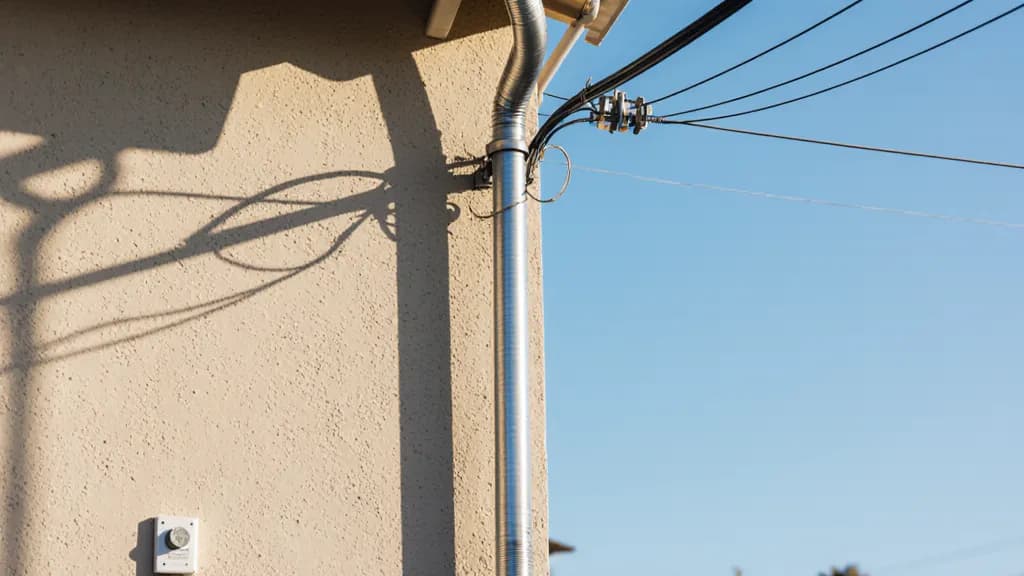
After a windy night, one of the most common calls we get is some version of "the pipe on my roof is bent and the wires are sagging." That pipe is your service mast, and when it fails it is one of the few electrical problems you cannot wait on. Here is what the mast and weatherhead do, how to spot trouble, and what replacement involves in Los Angeles.
What a Service Mast and Weatherhead Actually Do
On a home with overhead power, the utility's wires end at your roofline, and everything from that point in is yours to maintain. The mast-type service entrance receives those wires and carries power down to the meter:
- Service mast (riser): the vertical metal conduit, normally rigid or IMC, that penetrates the roof or runs up the wall.
- Weatherhead (mast head): the curved fitting at the top that sheds rain while letting conductors exit downward.
- Drip loop: the deliberate sag below the weatherhead so water drips off instead of running into the conduit.
- Service entrance conductors: the cables running inside the mast to your meter socket and main panel.
- Service drop: the overhead span from the pole to your weatherhead. This part belongs to the utility.
Signs Your Service Mast Needs Repair or Replacement
Some of these are urgent. Some can be scheduled. None should be ignored:
- The mast is leaning, bent, or has pulled away from the wall or roof flashing.
- The weatherhead is cracked, missing its bushing, or pointing upward instead of down.
- Exposed copper, cracked insulation, or frayed conductors where the wires enter the head.
- Rust streaks or corrosion running down the conduit toward the meter.
- A tree limb, ladder, or vehicle made contact with the mast or the drop.
- The meter socket is loose in the wall or scorched around the edges.
- Lights dim or flicker across the whole house when the wind blows.
That last one matters. Whole-house flickering that tracks with weather points to a loose service-entrance connection, not a bad fixture. Treat it as an emergency electrical problem — a compromised service connection can arc. If a mast is down or conductors are exposed, stay well clear and call the utility first.
Who Is Responsible — You or the Utility?
The dividing line is the weatherhead. The utility owns and repairs the service drop up to the point of attachment; the mast, weatherhead, conductors, meter socket and panel are the owner's. So a replacement is a coordinated job: your electrician does the work, but the utility must de-energize and later reconnect the drop.
Which utility you coordinate with depends on your city:
- Southern California Edison (SCE) serves most of the area we cover, including Los Angeles, Altadena, Arcadia, South Pasadena, San Marino, Sierra Madre, Alhambra, San Gabriel, Temple City, Monrovia and Monterey Park.
- Pasadena Water & Power (PWP) is Pasadena's municipal utility. Unlike SCE customers, Pasadena homeowners schedule disconnects through PWP, which also runs its own incentives — up to $1,000 toward a panel upgrade and up to $600 toward a home EV charger. Confirm current terms with PWP.
- Glendale Water & Power (GWP) and Burbank Water and Power (BWP) are also municipal with their own programs — check the utility's current rebate program rather than assuming SCE figures apply.
How a Service Mast Replacement Works
A straightforward residential replacement follows the same sequence almost every time:
- Assessment. An electrician inspects the mast, weatherhead, conductors, meter socket and panel to determine whether the mast alone has failed or the whole service entrance is due.
- Permit. Service entrance work is permitted work in every city we serve. Your contractor pulls it; unpermitted service work causes problems at resale.
- Utility disconnect. A shutoff is scheduled with SCE, PWP, GWP or BWP. This is usually the step that sets the calendar.
- Replacement. Old mast, head and conductors come out; new rigid conduit, weatherhead, straps, flashing and conductors go in, with bracing or a guy wire if the mast runs high above the roof.
- Inspection. The city or county inspector signs off on the new service entrance.
- Reconnect. The utility reattaches the drop and re-energizes — power is typically out for part of a single day.
One practical note: if your service is already being opened up, this is the cheapest moment you will ever get to do an electrical panel upgrade. Combining it with a 200-amp service upgrade shares the permit, the shutdown and the labor — and if EV charger installation or a heat pump is anywhere in your plans, doing both at once avoids paying for a second shutdown later.
Cost and Timeline in Los Angeles
Roof pitch, mast height, conduit run and meter condition all move the number. As planning ranges for our area:
- Weatherhead or drip-loop repair only: a few hundred dollars, when the mast itself is sound.
- Full mast and service entrance conductor replacement: roughly $1,200 to $3,000 for a typical single-family home.
- Mast replacement combined with a 200-amp panel upgrade: commonly $3,500 to $7,000 depending on panel location, grounding and whether the meter socket is replaced.
Treat those as ballparks, not quotes, and confirm any rebate before counting on it. Field time is often a single day; the real timeline is driven by permit issuance and how far out the utility can schedule the disconnect — plan on one to three weeks for a non-emergency job.
Frequently Asked Questions
How high does a service mast have to be?
Height is set by the clearance the service drop needs, not a fixed number. The National Electrical Code generally requires at least 10 feet above finished grade at the drip loop, 12 feet over residential driveways and yards, and 18 feet over public streets. Your electrician sizes the mast to hit those clearances at your pole angle, and the inspector verifies it.
Can you use EMT for a service mast?
Generally no. A service mast has to physically support the pull of the overhead drop, and thin-wall EMT is not built for that load. Rigid metal conduit (RMC) or intermediate metal conduit (IMC) is the standard choice — using the wrong conduit is a common reason masts bend, and a common inspection failure.
Do I need a guy wire on my service mast?
Often, yes. Once a mast extends more than roughly three feet above the roof, the leverage from the drop is enough to bend it, so a guy wire or brace counteracts the pull. Whether yours needs one depends on mast height, conduit size and the direction the drop pulls.
Does a damaged weatherhead require a permit to fix?
Yes. Replacing the mast, weatherhead or service entrance conductors is permitted work in Los Angeles and surrounding cities because it touches the service entrance and requires a utility disconnect. A licensed contractor pulls it as part of the job; skipping it surfaces later at a home sale or insurance inspection.
My power is out but my neighbors have power — is it my mast?
It can be. An outage isolated to your house often points to something on your side of the weatherhead: a failed service conductor, a loose meter connection, or a damaged mast. Losing only half your circuits is a classic sign of one open service leg. Either way it needs diagnostic troubleshooting rather than guesswork at the breaker panel.
Talk to a Licensed Los Angeles Electrician
911 Construction & Electric Inc. is a licensed, bonded and insured C-10 electrical contractor (CA Lic. #1027421) based in Pasadena, serving Los Angeles, Burbank, Glendale, Altadena, Arcadia, the San Fernando Valley and the San Gabriel Valley. We handle service mast and weatherhead replacement, panel upgrades and utility coordination — SCE, PWP, GWP and BWP — with 24/7 emergency response. Request a free estimate or call 747-255-8595.
Keep Reading
5 min read
Electrical Preventive Maintenance in Los Angeles
A loose lug or a scorched neutral rarely announces itself. It shows up as a breaker that trips on the hottest afternoon of the year, or a tenant calling at closing time about ha…
Read article →
6 min read
Electrical Panel Maintenance in Los Angeles: Checklist
Most homeowners service the furnace, flush the water heater and change the HVAC filter on a schedule. The electrical panel — the single component every circuit in the building d…
Read article →
6 min read
Home Battery Backup Installation in Los Angeles
A red-flag wind warning goes up, the power drops, and suddenly the most important appliance in the house is the refrigerator. That is usually the moment Los Angeles homeowners s…
Read article →Have an electrical project in mind?
Talk to a licensed electrician today — free estimates, 24/7 emergency service.