Electrical Tips
Electrical Load Calculation in Los Angeles: A Guide
5 min read
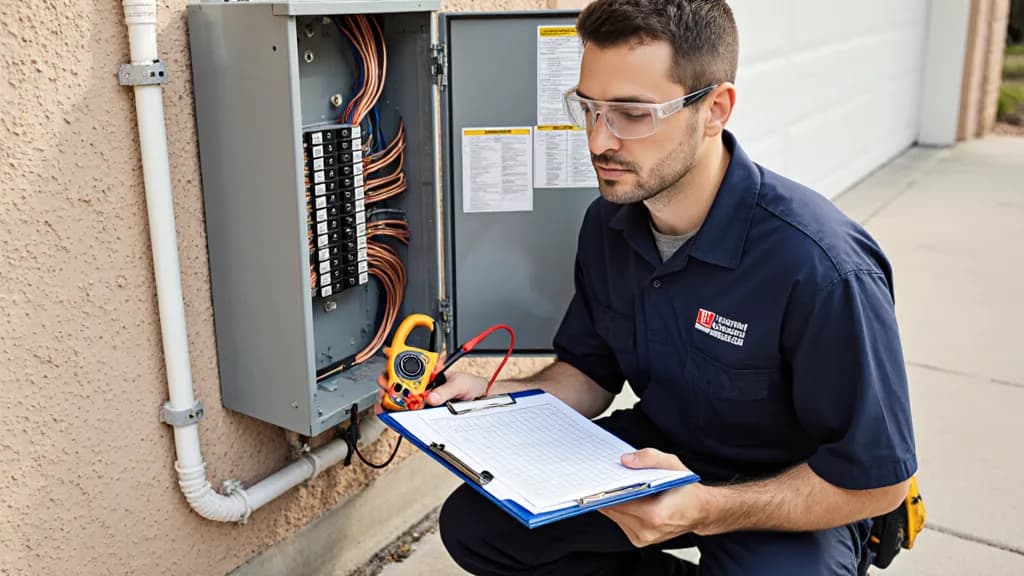
Before anyone runs conduit for an EV charger installation or swaps in a heat pump, someone has to answer a math question: can the existing service actually carry it? That answer comes from an electrical load calculation, and in Los Angeles it is the single document that decides whether your project is a simple circuit add or a full service upgrade.
What an Electrical Load Calculation Actually Is
A load calculation is a documented tally of every load your home can draw, adjusted by the demand factors in NEC Article 220, converted to amps, and compared against the rating of your service. It is not a guess based on how many breakers are open in the panel — open breaker spaces tell you nothing about available capacity.
Plan checkers at LADBS and the building departments in Pasadena, Glendale, Burbank and the San Gabriel Valley cities ask for this sheet on permits involving new 240-volt loads. So does your utility, when the calculated demand exceeds what the existing service drop or transformer was sized for.
The Three Methods an Inspector Will Accept
Standard method (NEC 220, Part III)
The long-form approach. General lighting and receptacle load is figured at 3 VA per square foot, plus two 1,500 VA small-appliance circuits and a 1,500 VA laundry circuit. Demand factors knock the total down — the first 3,000 VA counts at 100%, the remainder at 35%. Then fixed appliances, the dryer, the range, the larger of heating or cooling, and any EV charger get added at their code-defined values.
Optional method (NEC 220.82)
For a single dwelling on a service of 100 amps or more, the optional method counts the first 10 kVA of general load at 100% and everything above it at 40%, with HVAC handled separately. It usually produces a smaller number than the standard method, which is why it is the one that often saves a panel upgrade.
Existing dwelling maximum demand (NEC 220.87)
The one most homeowners have never heard of. If a home has been occupied for at least a year, actual metered peak demand can be used instead of a theoretical tally. Options include:
- Utility interval data showing the highest 15-minute demand over the previous 12 months
- A 30-day recording on the service, with the measured peak increased by 125%
- The new load added on top of that measured peak, then compared to the service rating
For a 1950s Highland Park or Alhambra house whose real peak draw is modest, this method frequently proves the existing 100-amp service can carry a Level 2 charger — no service change required.
Why Load Calculations Come Up So Often Here
Four things drive almost every load calculation request we run:
- EV charging. A charger is a continuous load, so code requires sizing at 125% of its rating. A 48-amp charger is treated as 60 amps of demand.
- Electrification. Heat pumps, heat pump water heaters, induction ranges and electric dryers replace gas appliances one at a time, and each one lands on the panel.
- ADUs and additions. Any new dwelling unit or square footage changes the general lighting load outright, which is why ADU wiring plans always include a fresh calculation.
- Solar and battery. Interconnection review needs the calculated load and busbar rating to confirm the backfeed is legal.
What We Need From You to Run One
The calculation is only as good as its inputs. Expect to be asked for conditioned square footage, the panel's amperage and busbar rating, nameplate ratings for HVAC and major appliances, the planned new load, and a photo of the panel label and meter. If we are pursuing the 220.87 route, we will also ask you to pull your interval or demand history from your utility.
Most of this takes a single site visit, and the sheet that comes out of it is what goes into the permit package.
When the Numbers Say You Need More Service
If calculated demand lands above your service rating, the fix is usually a 200-amp electrical panel upgrade, and occasionally a 400-amp service for large homes with multiple chargers. Budget in the low-to-mid four figures for a straightforward 200-amp change-out in Los Angeles, more when the meter has to move, the mast is deteriorated, or the utility has to replace the drop. Prices vary by scope and by city — get it in writing.
Utility coordination differs depending on where you live. Most of the county is Southern California Edison, which handles service planning and any transformer or drop work. Pasadena homes go through Pasadena Water & Power instead, Glendale through Glendale Water & Power, and Burbank through Burbank Water and Power — municipal utilities with their own service planning desks and their own rebate programs, so confirm current terms directly with them.
There is also a middle path worth asking about: load management. An EV energy management system that sheds charger load when the house is drawing heavily can satisfy the calculation on an existing service, and it is often far cheaper than a service upgrade.
Frequently Asked Questions
How much does an electrical load calculation cost in Los Angeles?
Many contractors fold it into the estimate for the work itself; as a standalone document it is typically a modest flat fee. Ask whether it is credited back if you proceed.
Can I do my own residential electrical load calculation?
You can run the arithmetic — the NEC 220 worksheets are public. But plan check generally wants it stamped or submitted by the licensed contractor pulling the permit, and an error here surfaces as a rejected permit or a failed inspection.
Does adding an EV charger always require a panel upgrade?
No. Between the optional method, the 220.87 existing-demand method, and load management, plenty of 100-amp and 125-amp services in Los Angeles accept a Level 2 charger as-is. The calculation is what settles it.
How long is a load calculation valid?
Until the loads change. Add a heat pump or a second charger after the fact and the sheet has to be redone, because the permit for that new load stands on its own calculation.
What happens if the load calculation is wrong?
Understate the load and you risk nuisance tripping, an overloaded service, and a failed inspection. Overstate it and you pay for a service upgrade you never needed. Both are avoidable with accurate nameplate data.
Get the Calculation Done Right
911 Construction & Electric Inc. is a licensed, bonded and insured C-10 electrical contractor (CA Lic. #1027421) serving Los Angeles, Pasadena, Burbank, Glendale, Altadena, Arcadia, the San Fernando Valley and the San Gabriel Valley. We run the load calculation, pull the permit, and do the work — or tell you honestly that you do not need the upgrade. Request a free estimate or call 747-255-8595.
Keep Reading
5 min read
Electrical Preventive Maintenance in Los Angeles
A loose lug or a scorched neutral rarely announces itself. It shows up as a breaker that trips on the hottest afternoon of the year, or a tenant calling at closing time about ha…
Read article →
6 min read
Electrical Panel Maintenance in Los Angeles: Checklist
Most homeowners service the furnace, flush the water heater and change the HVAC filter on a schedule. The electrical panel — the single component every circuit in the building d…
Read article →
6 min read
Home Battery Backup Installation in Los Angeles
A red-flag wind warning goes up, the power drops, and suddenly the most important appliance in the house is the refrigerator. That is usually the moment Los Angeles homeowners s…
Read article →Have an electrical project in mind?
Talk to a licensed electrician today — free estimates, 24/7 emergency service.