Electrical Tips
Emergency Lighting & Exit Sign Installation Los Angeles
5 min read
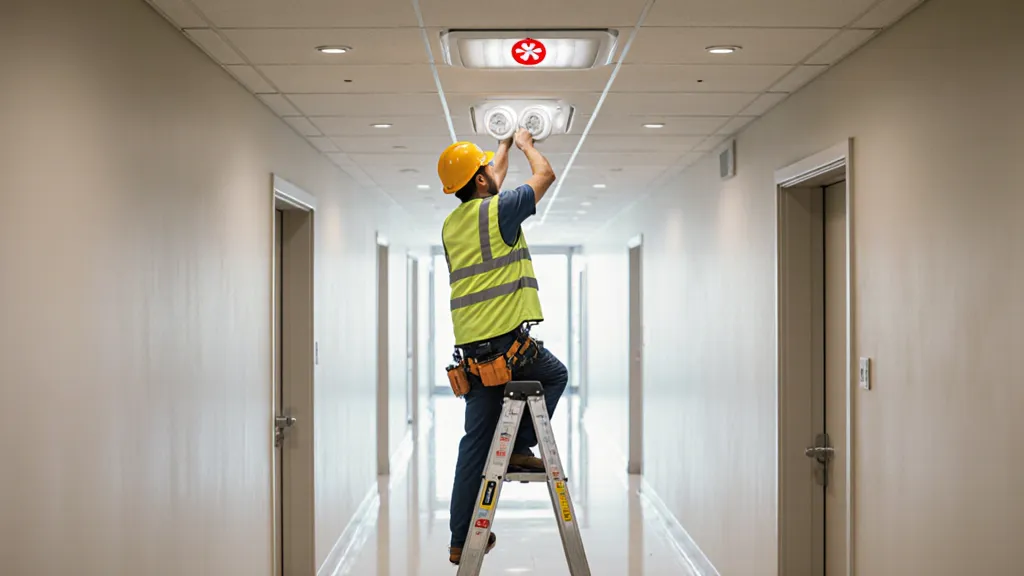
The only time emergency lighting matters is the moment a building loses power — which is also the moment you find out whether yours works. For most Los Angeles business owners, that discovery happens during a fire inspection instead, and it arrives as a correction notice.
Here is what California requires for emergency lighting installation and exit signs, how the testing rules work, and what a compliant retrofit looks like in an older LA building.
What California Code Requires
Egress illumination is not optional in commercial buildings. Under the California Building Code (Chapter 10) and the California Fire Code, spaces requiring two or more exits generally need:
- Illuminated exit signs at every required exit, visible from the direction of egress travel
- Emergency egress lighting along corridors, stairways, aisles and the exit discharge
- At least 90 minutes of illumination after normal power is lost — from batteries, a generator, or a separate service
- An average of roughly 1 foot-candle along the egress path at floor level when the system first activates, which is permitted to decline across the 90 minutes
Your local fire authority — LAFD in the City of Los Angeles, or your own city's fire department in Pasadena, Glendale, Burbank and the San Gabriel Valley — is the authority having jurisdiction and confirms the final numbers at inspection. That is why fixture spacing is worth laying out properly rather than estimating.
Where Signs and Egress Fixtures Actually Go
Placement is where most self-installed systems fail. The pattern that holds up:
- At each required exit door — an illuminated sign directly above or adjacent to it
- At every corridor change of direction, so an occupant always has a sign in view; where the path isn't obvious, a directional chevron sign is required
- Stairways and landings, including the discharge at the bottom
- The exterior exit discharge — the path from the door to a public way needs illumination too, and this is the requirement people forget most often
- Windowless rooms and large open areas — warehouses, assembly spaces and open offices need coverage across the floor, not just at the doors
In practice that means combination units (an exit sign with two adjustable heads) at the doors, plus twin-head fixtures down the aisles. We design that as part of broader commercial lighting installation and upgrades so the emergency and normal lighting are planned together.
Testing: The 30-Second and 90-Minute Rules
This is what turns up on nearly every inspection report, because the hardware is usually fine and the records are missing. Two recurring tests are required:
- Monthly — a 30-second functional test of every unit: press the test button, confirm the lamps light and the charge indicator returns.
- Annually — a full 90-minute duration test. The unit must stay lit the entire time on battery alone. This is what catches an aging battery that passes a quick button press but dies at minute twenty.
- Written logs of both, kept on site for the inspector.
Batteries in self-contained fixtures typically last around three to five years, so failures cluster once a building's units are all the same age. Self-testing fixtures run these checks automatically and flag failures with an LED — usually worth it past a dozen units.
Retrofits in Older Los Angeles Buildings
Much of our commercial work sits in buildings from the 1920s through the 1970s: Old Town storefronts, mid-century office suites, San Gabriel Valley industrial bays. What we find:
- Incandescent exit signs still in place, burning out constantly and drawing far more power than an LED replacement
- No exterior discharge lighting, because the original layout stopped at the door
- Egress fixtures on a switched circuit — a violation, since the supply must be unswitched so it cannot be turned off
- No spare panel capacity for new circuits, which makes an electrical panel upgrade the first step
- Aging ceiling wiring that needs repair or replacement before new fixtures are tied in
For a tenant build-out, put the egress plan into the new construction electrical drawings from the start — adding it after the ceiling closes costs considerably more.
Cost and Timeline
Pricing varies with fixture count, ceiling height, conduit runs and access, so treat this as planning guidance rather than a quote. Swapping an LED combination unit one-for-one on existing wiring is a modest per-fixture job; new fixtures needing fresh circuits and conduit to an unswitched source run meaningfully higher, and a battery-only replacement is the cheapest option when the fixture itself is sound. A small retail suite is often one day; a warehouse or multi-tenant floor takes several.
Most of the area we serve is on Southern California Edison, while Pasadena, Glendale and Burbank run their own municipal utilities — Pasadena Water & Power, Glendale Water & Power and Burbank Water and Power. Buildings that lose power often are exactly the ones where a failing egress system gets noticed. If yours drops power without warning, that is an emergency electrician call.
Frequently Asked Questions
How do you test emergency lights?
Hold the test button for at least 30 seconds and confirm the emergency lamps light and stay steady — monthly, on every unit. Once a year, run the full 90-minute test by holding the switch or cutting power to the circuit, then log the result.
How long do emergency lights have to stay on?
Ninety minutes on battery or backup power after normal power is lost. A unit that goes dark sooner fails and needs a new battery or fixture.
Can exit signs be battery-only, or do they need to be wired?
Standard illuminated signs must connect to building power with battery backup, on an unswitched supply so they cannot be turned off. Photoluminescent signs are accepted only in limited circumstances and require continuous charging illumination — confirm with your fire inspector first.
How much does emergency lighting installation cost in Los Angeles?
It depends on fixture count, whether new circuits are needed, and ceiling access. Direct replacements are the least expensive; adding coverage to a space that has none is the most involved. We give a free written estimate after walking the egress path.
Who inspects emergency lighting, and how often?
Your local fire department, on a cycle set by occupancy type — assembly and high-occupancy uses are inspected more often. The inspector checks placement, operation, and your monthly and annual test logs.
Get It Right Before the Inspection
911 Construction & Electric Inc. is a licensed, bonded and insured C-10 electrical contractor (CA Lic. #1027421) serving Los Angeles, Pasadena, Burbank, Glendale, Altadena, Arcadia, the San Gabriel Valley and the San Fernando Valley. We lay out egress lighting and exit signage to pass the first time, replace failing units, and set up test logs you can hand an inspector. Request a free estimate or call 747-255-8595 — 24/7 emergency service available.
Keep Reading
5 min read
Electrical Preventive Maintenance in Los Angeles
A loose lug or a scorched neutral rarely announces itself. It shows up as a breaker that trips on the hottest afternoon of the year, or a tenant calling at closing time about ha…
Read article →
6 min read
Electrical Panel Maintenance in Los Angeles: Checklist
Most homeowners service the furnace, flush the water heater and change the HVAC filter on a schedule. The electrical panel — the single component every circuit in the building d…
Read article →
6 min read
Home Battery Backup Installation in Los Angeles
A red-flag wind warning goes up, the power drops, and suddenly the most important appliance in the house is the refrigerator. That is usually the moment Los Angeles homeowners s…
Read article →Have an electrical project in mind?
Talk to a licensed electrician today — free estimates, 24/7 emergency service.